After the Prompt: What Makes Generated Music Production-Ready
A generated track is a performance without a production. What turns it into a record is the same work it has always been: arrangement, editing, sound selection, mix, master and metadata.
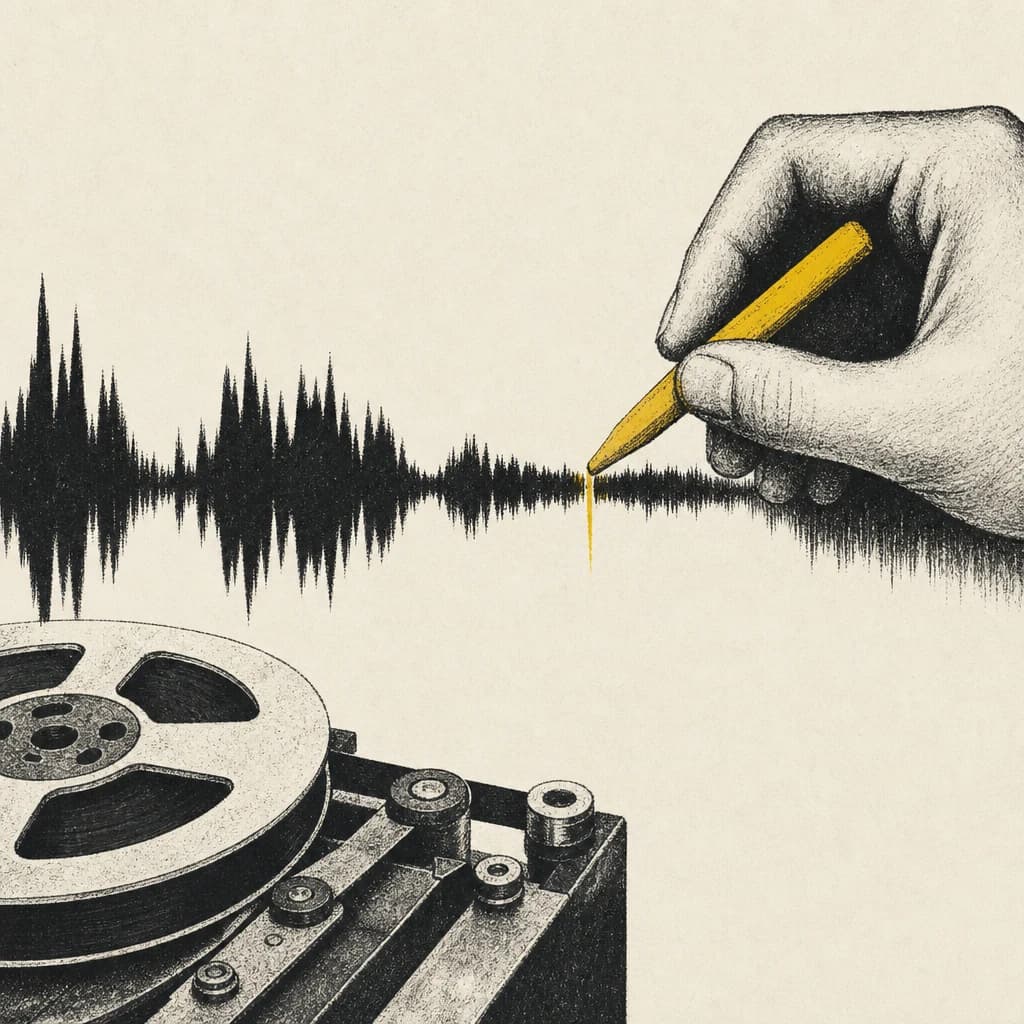
Every few weeks someone sends me a generated track with the same question attached: is this finished? I sit in a useful place for answering it. I produce and master records for my own catalog, and I build production software — AudioX, an online mastering environment, and a browser-based DAW among them — which means I spend half my time making finishing decisions and the other half trying to understand them well enough to encode them. The honest answer is almost always no, the track is not finished. Not because generation is illegitimate, and not because the output sounds bad. Usually it is because nothing in the track has been decided yet.
A generated track is a performance without a production. It arrives the way a demo arrives — a plausible whole, delivered all at once — except that a demo comes with a band who can play it again, and a generated stereo file comes with nothing behind it. Every balance is committed, every reverb baked in, every sound fused to its neighbours. What follows is a practical account of the work that turns that artifact into a record: arrangement, editing, sound selection, mixing, mastering and metadata. None of this work is new. That is the point.
Arrangement is a sequence of refusals
The most reliable tell in generated music is not fidelity; the systems produce clean audio. It is form. Generated arrangements drift toward continuous medium density: everything present at a moderate level, sections that shade into one another rather than turn. The material is often attractive. The shape is evasive. A record needs arrivals — a place where something enters that was withheld, a place where the floor drops — and arrivals only exist because someone refused to let those elements play everywhere else.
The rule I work to in my own ambient series, Dreamlight, is that every added voice has to justify itself against the quiet it displaces, and most candidates do not survive the question. On Reimagined Sonatas, a nine-track electronic album built on classical phrase-shapes, the longest piece holds seven and a half minutes together mostly through dynamics — statement, dissolution, return — because the dynamics were the structure, not an effect applied afterwards.
Practically, this means the first pass on a generated piece is destructive. Find the one passage that genuinely works. Cut or mute around it until it has something to arrive from. Decide what the second half knows that the first half does not. An arrangement is a set of commitments, and a file that never commits is not yet music you can release — it is music you can sample.
Editing is where the record starts to exist
Because the render is committed, the honest way to treat it is as raw material: chop it, resample it, mute it, rearrange it. Nothing about a generated bounce is sacred, and treating it as sacred is the main way people end up 'finishing' tracks by adding a limiter and nothing else.
Feel lives in the edit. Boom Bap Essentials, my drum study, works because the snare sits behind the grid on purpose, and because the samples keep their vinyl noise — the noise is part of the tuning. Generated rhythm tends to be quantized-polite; whatever swing it has was nobody's choice. Nudging a backbeat, tightening a phrase ending, letting a fill land late: these are small, cheap edits, and they are the difference between a groove and a metronome wearing clothes.
Sound selection is the same discipline at the level of timbre. Keep the generated bed and replace the lead with a played or programmed part; or keep a striking lead and rebuild the bed under it. Hybrid tracks — generated texture under a human foreground, or the reverse — are usually stronger than either pure case, because at least one layer was chosen rather than accepted.
You cannot mix what you cannot reach
Mixing a finished stereo file is surgery through the skin. Mid-side EQ, dynamic EQ, multiband compression — I use all of them on premasters, and they are repair tools, not design tools. They can tilt a balance a few decibels; they cannot move the vocal forward of the piano, or dry out a reverb that was printed into the room.
So the mix question for generated music is really an access question: can you get separable elements? Regenerate parts, replace parts, re-record parts — anything that gives you faders. The lesson I keep relearning in minimal work is that where a sound sits in the field matters more than what the sound is. Depth is placement, and placement requires access. A track whose every element sits at the same distance has not been mixed, whoever or whatever made it.
Mastering is judgment with meters on
Mastering is where I see most generated tracks arrive, usually with the request to make it loud. Loudness is the least of it. Streaming platforms normalize playback level, so a slammed master buys nothing except lost transients; what delivery actually requires is measured conformance — integrated loudness in a sensible range for the destination, true-peak ceilings that survive lossy encoding, correct rates and formats per target. That part of mastering is measurement, and measurement automates well.
Building AudioX has made the boundary very clear to me. A tool can be good at the checkable layer: meters, ceilings, conformance, comparison against reference material at matched loudness. The questions that decide whether a master is right do not check. Is the low end a choice or an accident? How much density can this chorus carry before it stops feeling bigger and starts feeling smaller? Does the master respect the quiet passages, or does it treat them as a problem to fix? Machines are good at measurement. Meaning is still manual.
The working method is old and unglamorous: reference records you trust, level-matched comparison, small moves, and the willingness to send a track back to the mix — or, for generated material, back to the edit — when mastering cannot solve what it is being asked to solve.
Metadata is part of the record
A track with no credits, no writer, no identifier and a filename like final_v3_new.wav is not a release; it is a file. Every published object in my studio carries a catalog number, and at Poppy Seed Music, the label I run, we credit the poets whose texts we set — Ahmed Faraz, Amir Khusrau, Kabir — as writers on the release itself, because credit is both an ethical obligation and the way anyone finds anything later.
Generated music makes this layer harder and more important at the same time. Deciding what to declare — who wrote what, what was generated, what was played, what the work is called and where it sits in a sequence — forces the authorship question into the open, in writing, before distribution. If you cannot fill in the writer field honestly, the track is telling you it is unfinished in a more fundamental way than any meter can.
Where authorship lives now
None of the above is a defense of tedium for its own sake. Generation is genuinely useful in my practice — as sketching, as texture, as a way of auditioning arrangement ideas faster than I could build them. What it has not done is move the finish line. Authorship did not disappear when the first note stopped being played by hand; it moved — into selection, arrangement, editing, placement, the master, the name, the credits.
Production-ready turns out to be a simple standard: could you defend every audible decision in the track, because you made it? On a generated file fresh out of the model, the answer is no, for the sufficient reason that no one has made any decisions yet. The prompt, it turns out, is the smallest decision in the file.