The Catalog Is the Interface
Organization, metadata, art direction and sequencing decide whether a body of music can be found at all. Notes from a twenty-eight-release label and a thirty-thousand-station index.
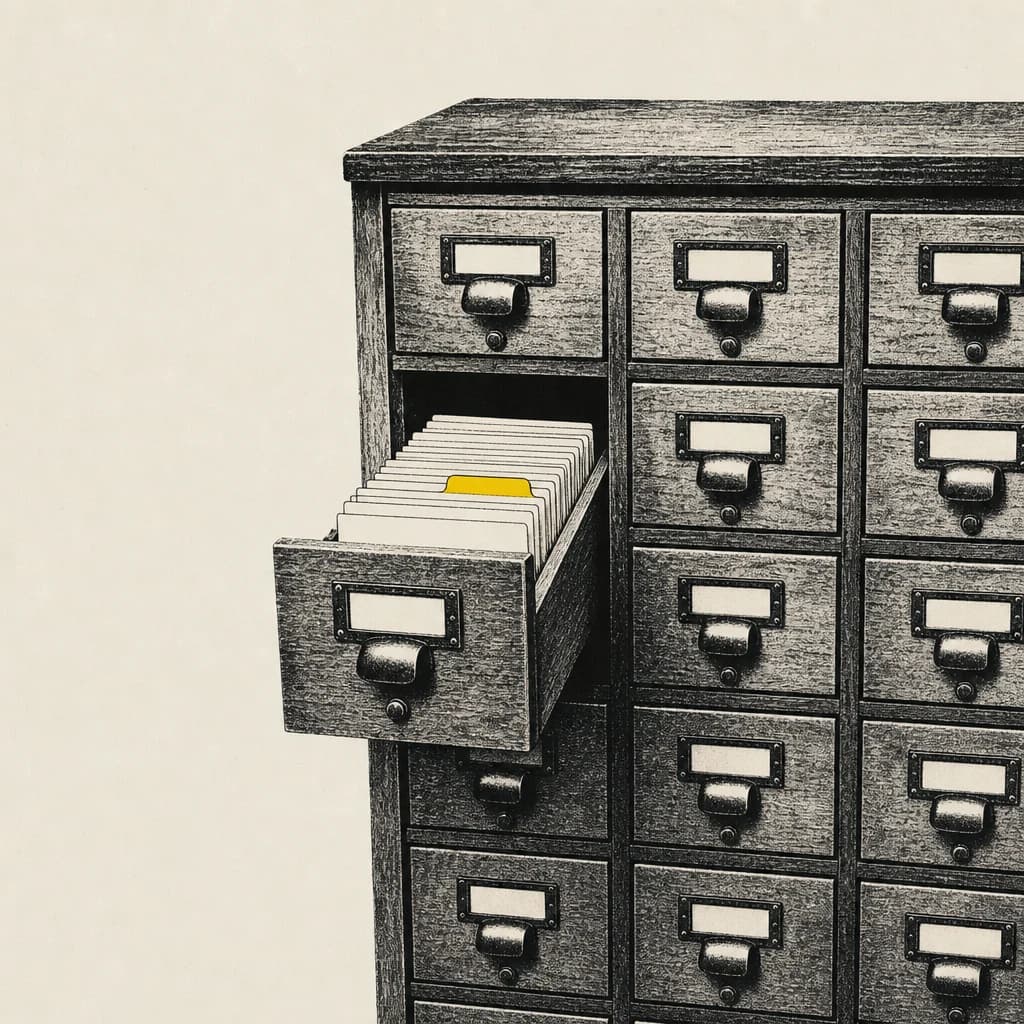
Poppy Seed Music, the label I run, has released twenty-eight videos to date, including two full albums. Twenty-eight is a modest number by industry standards and a large one by human standards: it is already past the point where anyone — including me — can hold the whole catalog in their head. Somewhere around the second dozen releases, I stopped thinking of the catalog as a list of things we had made and started thinking of it as the thing we were making. This essay is about that shift.
The claim in the title is meant literally. For a body of recorded work, the interface is not the player, the website or the app; those change. The interface is the catalog itself — the names, credits, sequence, artwork and structure through which the work can be reached. Organize it well and every surface built on top of it works. Organize it badly and no amount of design rescues it.
A list is not a catalog
The rawest form of our catalog is a channel page: a reverse-chronological scroll of titles. A scroll is an interface with exactly one question it can answer — what is newest? — and our work does not organize itself by newness. A ghazal setting from last year and one from this year belong together; a full album and the single beside it do not.
The first repair was naming. Look down our actual release list and the titles carry their own classification: 'Rangish Hi Sahi | Ghazal | Ahmed Faraz'. 'More Piyā Ghar Aae || Amir Khusrau (Official Lyric Video)'. 'Talash | Raga Classical Fusion | [Full Album]'. Those pipes and brackets are not decoration; they are fields. Form, writer, format — enough structure that a listener scanning titles, or a search engine parsing them, can reconstruct the shape of the catalog from the names alone. Naming is retrieval. It is the cheapest interface work there is, and it has to be done at release time, because nobody ever goes back.
Format labels do the same quiet work. Our releases declare themselves as official videos, visualizers or lyric videos, and the distinction is a promise about what the viewer will get — a full visual production, a listening surface, or the words themselves foregrounded. A lyric video is the right format for a Khusrau text precisely because the text is the event. When format is labeled honestly, the catalog stops overselling its own entries, and the listener learns to trust the labels — which is another way of saying the interface works.
Credit is a search key
The catalog decision I would defend hardest is treating poets as first-class writers. Our releases set Nasir Kazmi, Ahmed Faraz, Shiv Kumar Batalvi, Sahir Hoshiarpuri, Amir Khusrau and Kabir, and each is credited by name on the release itself. The ethical case is obvious. The interface case is just as strong: a credit is an axis. Credit Faraz properly and the catalog acquires a Faraz shelf; someone who arrives through one ghazal can find the other.
The same is true of performers. Farah Zoya appears on ten of our twenty-eight releases, and because she is named on each one, the catalog itself tells her story: early visualizers, then full videos, then collaborations. We never wrote the phrase 'artist development' anywhere — the credits, read in sequence, are the case study. A catalog with thin credits has no shelves; every release is an orphan, findable only by title or by luck.
Sequencing against the feed
A feed sequences by recency; an album sequences by argument. We shipped Talash and Neo Raag, our raga fusion albums, as continuous long-form works, because twenty minutes with an arc says something about raga-based music that a handful of shuffled singles cannot: that the form thinks in long spans, and that the catalog is willing to think alongside it.
My electronic album Reimagined Sonatas is sequenced the same way — it opens in liquid and closes in silence, and the piece that carries the album's thesis sits in the long middle. Sequence is metadata too. The order in which a body of work presents itself is an editorial claim about what the work means, and surrendering that order to a feed is surrendering the claim.
Curation is sequencing applied to the catalog as a whole. On this studio's site we present six Poppy Seed releases in depth and hold the remaining twenty-two as the archive behind them — not because the archive is weak, but because a visitor's first hour with a catalog is itself a sequence, and it deserves to be composed. Twenty-eight equal tiles ask the visitor to do the editing. Six chosen releases, each with a stated reason, do the editing for them and invite them deeper.
Numbering as a promise
On this studio's own site, every published object carries a catalog mark — SR–W for case studies, SR–S for production studies, SR–J for journal pieces like this one. The habit is borrowed openly from record-label and archival practice, and it earns its place. A number is a promise that the item belongs to a system: that it was made deliberately, that it has neighbours, that it can be cited and retrieved.
The marks go down to the track level — a piece inside the Reimagined Sonatas study carries an ID like SR–S02·06, series then position — so a single recording can be pointed to as precisely as a page in a book. That looks fussy until the first time you need to tell a collaborator exactly which recording you mean.
Numbering also disciplines the publisher. The moment releases get numbers, gaps and duplicates become visible, and you can no longer quietly pretend the weak material is not part of the body of work. Curation stops being a mood and becomes an act you can audit.
Thirty thousand stations, same lesson
The largest catalog I work with is not mine. Spinn Radio, the listening product I designed and built, streams from Radio Browser, a community-maintained directory of live stations — tens of thousands of them, across more than two hundred countries. We do not own that catalog and I would not claim it; the community built it. What we built is the interface to it, and nearly all of that work turned out to be catalog work: scoring stations, tiering an index of roughly thirty thousand of the highest-value entries in our own database, separating the streams that verifiably play from the ones that do not, and precomputing a small geographic seed so a globe full of stations appears instantly rather than eventually.
None of that pipeline is visible in the interface, and everything about the interface depends on it. When discovery in Spinn feels light, it is because the effort happened earlier, in ranking and verification and indexing. A directory left raw is unusable at that scale; catalog structure is what turns a heap into a place.
The work that looks like administration
The pattern across a twenty-eight-release label and a thirty-thousand-station index is the same. Naming, credits, sequence, numbering, verification — this work is routinely filed under administration: done last, done grudgingly, or skipped. Filed correctly, it is design. It decides what can be found, what accumulates into a shelf, and what reads as a body of work rather than a pile of output.
So the practical advice is unexciting, and I mean every word of it. Write the credits before the release. Put the form in the name. Sequence like it matters. Number the things. The catalog is the interface; build it like one.